



"Admiralty Arrow Antique Glass Bottles"


Historical Background, Publications & Notes

The Admiralty Arrow, or Broad Arrow :

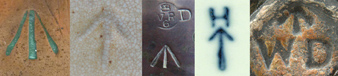
The Admiralty Arrow, or Broad Arrow was used to identify material belonging to the British Crown. The Broad Arrow was also referred to as 'crows feet'.   The mark was used on all manner of government property, and later its use was extended throughout the British Commonwealth.  For instance marks on Canadian Government property frequently used the arrow surrounded by the letter "C" and was in use at least until the 1950's. No item was too small to escape the broad arrow mark.  The photograph below shows a brass screw recovered from Esquimalt harbour.  Being a servant of the crown myself, there are days this particular artifact takes on a special significance.

broad arrow on a screw

The origin and earliest use of the broad arrow symbol are unknown. It could be related to the actual arrow, longbows and bowmen being a key part of the English army in the Middle ages. Broad Arrow Tower, built by Henry III of England between 1238 and 1272, in the Tower of London is said to be named after the royal property mark. Invention of the mark is frequently attributed to Henry Sydney, 1st Earl of Romney, who served as Master-General of the Ordnance from 1693 to 1702, since the pheon (broad arrow) appears in the arms of his family, but it is known to have been in use earlier than this. There is also an unsubstantiated claim that a document dated 1330, issued by Richard de la Pole, the King's Butler, for the purchase of wine shows that in order to make sure that ownership could be readily established as King's property, he marked each item with an arrow from his own Coat of Arms.

  ordinance survey marker

Ordnance Survey Marker with WD, in Bermuda

Early use of the broad arrow can be found on some objects recovered from the Tudor ship Mary Rose, which sank in 1545. Bronze sheaves for rigging blocks, spoked wheels for gun carriages, bowls and wooden tankards were found to bear this mark.

Similar to hallmarks, it is currently a criminal offence to reproduce the broad arrow without authority. The Embezzlement of Public Stores Act 1698 in clause 41 makes it illegal to use the "broad arrow / King's mark" on any goods not for His Majesty's government's use.


 The broad arrow frequently appeared on military boxes and equipment such as canteens, bayonets and rifles, as well as the British prison uniform from the 1870s, and even earlier, that of transportees in British penal colonies such as Australia. The broad arrow marks were also used by Commonwealth countries on their ordnance (as noted above).

In both the United States and Australia the broad arrow mark was used on trees reserved for the Royal Navy.

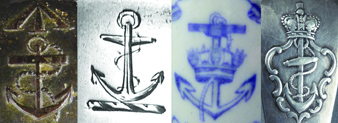
 Glass bottles were marked with the arrow and/or an anchor on a seal as early as the late 1700's.  The initials of the ruling monarch may also be included on the bottle or seal, such as VR for Queen Victoria; GR for King George, and WR for William IV.  Later these marks were incorporated with the raised markings on the bottle, usually with one or two letters such as N one presumes for Navy and WD which stands for War Department. I have seen a number of miscellaneous letters, which I hope to someday identify.

 The War Department acceptance mark with the WD and arrow replaced the Board of Ordnance which was created in 1544 by Henry the VIII ( marked with a “BO” and arrow ) in 1855 and was discontinued in the late 1890’s. Glass bottles bearing the WD and arrow mark fit this time frame. It must also be kept in mind that once manufactured, these bottles could have been in used for decades.  I am not aware of any bottles marked with the BO and arrow.

 The initials of the ruling monarch may also be included on the bottle or seal, such as VR for Queen Victoria; GR for King George, and WR for William IV.  Later these marks were incorporated with the raised markings on the bottle, usually with one or two letters such as N one presumes for Navy and WD which is assumed to be War Department. I have seen a number of miscellaneous letters, which I hope to someday identify.

Much of the above information can be credited to Wikipedia

The Story of Lime Juice and the Royal Navy

The story of lime juice and the Royal Navy dates back over 250 years and has given the British people in general the nick-name of “Limey”.

In 1747 British physician James Lind performed a now famous clinical trial on twelve of his men suffering from scurvy. He divided the men into six groups, receiving daily, in additional to their normal diets, either: 2 oranges and 1 lemon; cider; dilute sulfuric acid; vinegar; sea water; or a mixture of drugs. After 6 days the men receiving the citrus fruits were well, all ten others remained ill. This and other experiments were later published in Lind's A Treatise on Scurvy, 1753.

It appears Captain James Cook was the first to pick up on Lind’s work insisting his crew have a daily ration of sauerkraut and rob of lemon (a form of concentrated lemon juice made by evaporating it over a fire until it acquires the consistence of a syrup which will prevent fermentation).

 The British Admiralty, despite the huge losses incurred from this devastating condition, and the work of Lind and the success of Cook waited 48 years until 1795 before decreeing that daily rations of fresh lime juice be given to all sailors in the British Navy.

As an interesting historical note Gavin Menzies in his book “1421 The Year China Discovered the World “claims the Chinese knew the dangers of scurvy and its cure over 300 years earlier. During the great voyages of 1421 to 1423 “enough citrus fruit – limes, lemons, oranges, pomelos and coconuts – was taken on board to give every man protection against the disease for three months”.  Perhaps the Chinese should have had the "Limey" nick-name.

The next advance with lime juice came in 1865 when Lauchlin Rose , whose family was prominent in the Edinburgh ship-building industry founded L. Rose & Company. At this time ships were carrying supplies of lemon and lime preserved in rum and in 1867 Rose patented a process that preserved the citrus juice without the addition of alcohol. His alcohol-free preserved juices quickly became the popular choice of fleet owners (who were probably happy to have sober scurvy free sailors).  That same year, the Merchant Shipping Act was passed, requiring all vessels of the Royal Navy and Merchant to carry lime juice for daily rations. Rose’s Lime Juice sales skyrocketed. As an additional note the L.Rose & Company produced some very attractive ornately decorated bottles for their product.

The black glass bottles marked “LIME JUICE” with the arrow date from around the late 1860’s and I would speculate they contained Rose’s patented lime juice.

I have had some interesting comments on the black glass seals that pre-date the lime juice marked bottles.  Chriss Addams an archaeologist working in Bermuda states the earlier versions which had crown ownership seals were  a concoction of opiates used in-conjunction with various medical practices. It was the way the "crown" controlled (or tried to) the importation and control of opiates”.  Chriss Addams has a web site for his underwater archaeology work in Bermuda.

Given the cost of producing sealed bottles in the late 18th and early 19th century it would make sense these bottles contained something more than lime juice.


Values of Admiralty Bottles:

When I started this page I had no plan to deal with values. Since then
I have become aware of at least one situation where the page was used
to wildly inflate the value of Admiralty bottles and I felt some comment was
necessary.  There is always a concern that placing values on this type of
artifact will contribute to the destruction of historic archaeological
sites. The reality is that historic bottles share many of the same attributes of
other antiques which carry value based on aesthetic appeal, rarity and
historical significance.
Perhaps my point can be made using a parody of a popular Visa card
commercial; a blue bottle, value $10, a blue bottle with an arrow mark,
value $50, a blue bottle with an arrow mark lying in the ground in relation
to other objects that sheds new light on part of our past, priceless! 

A note of thanks:

To "Antique Bottle Collector UK" magazine for publishing an article based on this web page in their Issue 19, Winter 2004, pgs 40-41. See their website at:  www.abc-ukmag.co.uk

I would also offer thanks to everyone who has contributed to this web page and those who have taken the time to send thanks and encouragement. 

Publications:

From Antique Glass Bottles, Their History and Evolution, by Willy Van den Bassche: He describes the black glass GR seal bottle as "An English utility bottle mainly used for pharmaceutical applications, c1800. Sealed 'GR' for George III - Rex, King of England and Hanover from 1760-1820. Bottles used in the British Navy or Army where owned by the Government and as such indicated by 'GR'.  Some later bottles were sealed 'WR' or 'VR' again indicating the property of the British State during the reign of William IV - Rex and Victoria Regina 1837-1902. There are about thirty seven different 'GR', 'WR' or 'VR' seals known (with a crown, an anchor, etc.) Captain James Cook (1728 - 1779) discovered during his scientific expeditions to the Pacific (1768-1771) that none of the crew on his sailing ship H.M.S. Endeavour died from Scurvy thanks to the drinking of 'Lime Juice'." Several of the black glass lime juice bottles and the sealed 'VR' bottles have been found in and around the Esquimalt Naval Base, on Vancouver Island.

Olive Jones, Glass of the British Military


Jones, Olive R. and E. Ann Smith, Glass of the British Military 1755-1820.

Stephen R. Bown, Scurvy: How a Surgeon, a Mariner and a Gentleman Solved the Greatest Medical Mystery of the Age of Sail. Stephen Bown (no known relation) gives a detailed history of Scurvy mainly from the point of view of the Royal Navy.  It documents the slow discovery that the disease was from a lack of fresh fruits and vegetables, and the ultimate use of lime juice for its prevention.

Stephen R. Bown, Scurvy: How a Surgeon, a Mariner and a Gentleman Solved the Greatest Medical Mystery of the Age of Sail.

If you have any questions, please feel free to Email us.
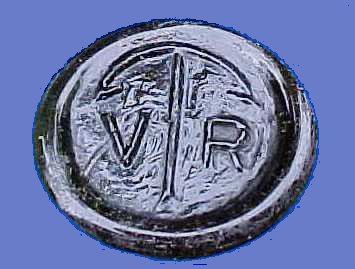
VR and anchor seal


This site created by Tom Bown and maintained by Linda Bown. Email us with comments.

Other Web Pages to visit:


IMPORTANT NOTICE: The images presented at this online gallery are copyright-protected © worldwide by Tom Bown. Any downloading, copying, distributing or other unauthorized use without prior written consent of the copyright holder is strictly forbidden.
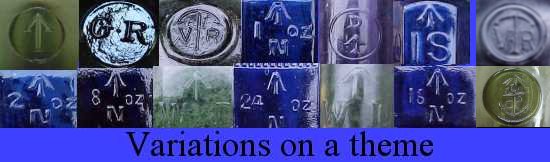

seals found on Admiralty Bottles