


"Admiralty Arrow Antique Glass Bottles"

Classic Victorian Poison Bottles used by the British Military:

There were a wide range of bottle types used by the British Military.  This page details many of the different poison bottles that were used.

Victorian Poison Bottles

By the mid nineteenth century public concern over accidental and non-accidental poisonings had reached the point where the British government was taking action. In 1863 “A Bill for the Prevention of Accidental Poisoning” was introduced to the house. The bill called for all poisons to be stored in special hexagonal bottles prominently labeled poison along with directions for use. Although the bill did not pass, many companies around the world adopted special bottles for poisons. The two main colours adopted were cobalt blue and an emerald green. The bottles also had distinctive shapes often with raised ribs or other designs and raised letters with the word poison. Two factors were at play, first, many people were illiterate so the colour would be associated with poison, second, in dim light the bottles would have a distinctive feel. Because of the attractive colour and unique designs Victorian poison bottles are particularly favoured by collectors.   


These are found in a variety of sizes, mostly in dark cobalt blue and to a lesser extent emerald green.  
Square poisons:

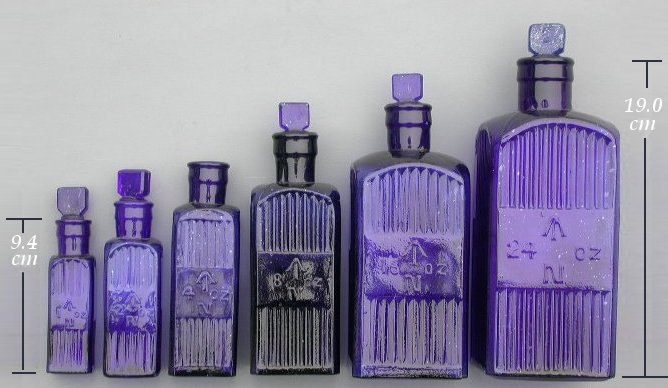
group of square admaralty arrow bottles

Square blue poison 1oz N

#201001:

Square blue poison 1oz N

2.7 cm. Square

Height: 9.4 cm.

Square blue poison 2oz N

#201002:

Square blue poison 2oz N

3.2 cm. Square

Height: 10.5 cm.

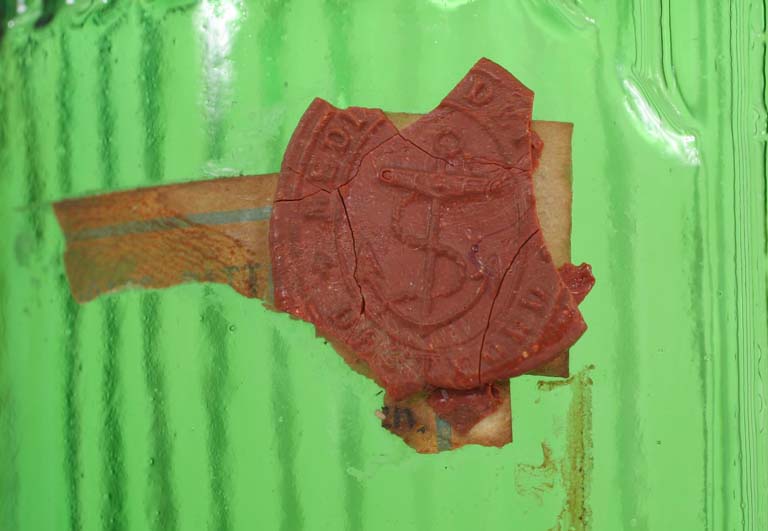
seal on 2 oz poison

The wax seal on this two ounce poison, identical to the one above, clearly shows the Royal Navy seal. The partial lettering appears to be an M on the upper left and EPOT (likely DEPOT) on the upper right. The word Deptford is clearly printed at the bottom. The wax seal is placed over a paper label which has only tiny portions remaining. The partial printing on the label is “ALTY  S” with the wax seal obscuring anything after the S. This may have read ADMIRALTY SEAL indicating where there was seal was to be placed. Below this is a hand written 67 or possibly 64. The contents of the bottle were likely hand written on the missing label.

The Deptford Dockyard was founded in 1513 by Henry VIII on the Thames and was one of the Royal Navy’s main dockyards.  In the 18th century a victualling yard was established alongside, where ships' stores and provisions were assembled. The dockyard was closed in 1869 but the victualling yard remained until 1961. The bottle was originally found in Australia and probably dates between 1890 and 1910 and clearly establishes the connection of these bottles to the Royal Navy.

wide mouth 2 oz poison

#201002v:

Wide Mouth Square blue poison 2oz

3.4 cm. Square

Height: 10 cm.


wide mouth 4 oz poison

201003v.

Square blue poison marked 4 

5.2 cm. Square

Height: 14.3 cm.


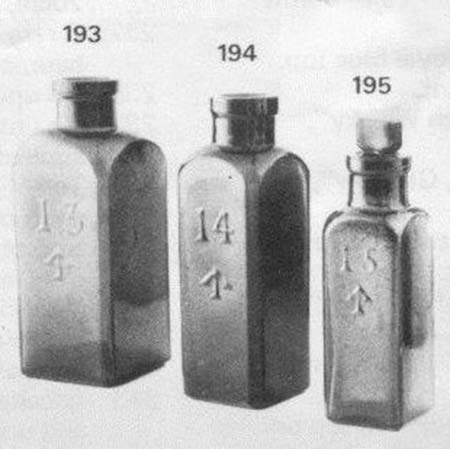
numbered poisons

This was a photo provided by Geoff Clarke of New Zealand showing three different numbered bottles in this series. 

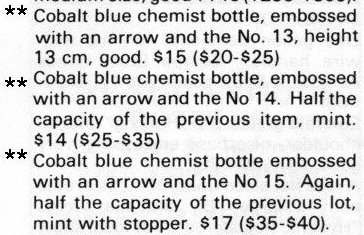
These appeared in a New Zealand bottle auction list a few years ago with the description copied below.  It becomes clear that the number on many of these bottles likely refers to contents instead of volume.description of auction list

12 oz blue poison

12 oz blue poison with ground stopper

6.3 cm. Square with beveled  corners

Height: 15.5 cm.

Height with stopper: 17.6

This style likely predates the ribbed versions bearing the words poison.


blue poison

This bottle is a reconstructed example recovered in Bermuda. The measurement are not available but are likely similar to the colourless 17 ½ .  This image was scanned from an older  photograph. Photo courtesy of  Chriss Addams of Bermuda.


Square blue poison 4oz N

#2001003:

Square blue poison 4oz N

4 cm. Square

Height: 13 cm.


 Square blue poison 8oz N

#201004:

Square blue poison 8oz N

5.2 cm. Square

Height: 14.5 cm.

Square blue poison 16oz N

#201005:

Square blue poison 16oz N

6.7 cm. Square

Height: 16.4 cm.

Square blue poison 24oz N

#201006:

Square blue poison 24oz N

7.7 cm. Square

Height: 19.0 cm.

32 ounce?

 Was a 32 ounce size made?

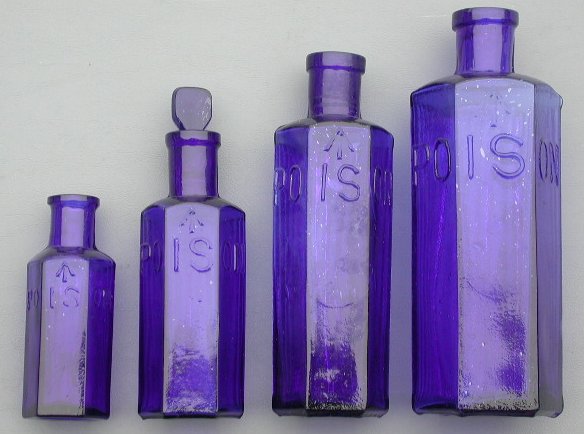
Hexagonal poisons: Small Arrow

small arrow hexagonal group

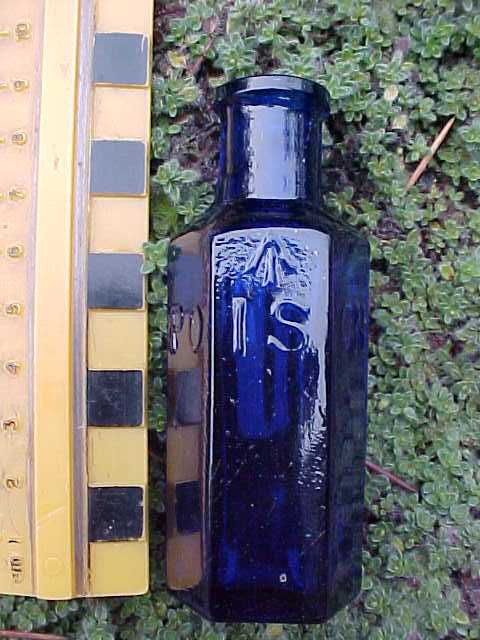
hexagonal blue poison

#301008:      Hexagonal blue poison

Base 3.3 cm. (widest point)      Height 8.8 cm.


hexagonal blue poison The bottle on the left was found in New Zealand .  It wasn’t until the two bottles were side by side that I realized the two were from distinctly different moulds (the one on the left with a shorter neck and sharper shoulder).

Hexagonal blue poison

#301009:

Hexagonal blue poison

Base 4.0 cm. (widest point)

Height: 11.2 cm.

Hexagonal blue poison

#301010:

Hexagonal blue poison

Base 4.4 cm. (widest point)

Height: 14.3 cm.

Hexagonal blue poison

#301011:

Hexagonal blue poison

Base  5.1 cm. (widest point)

Height:  16 cm.

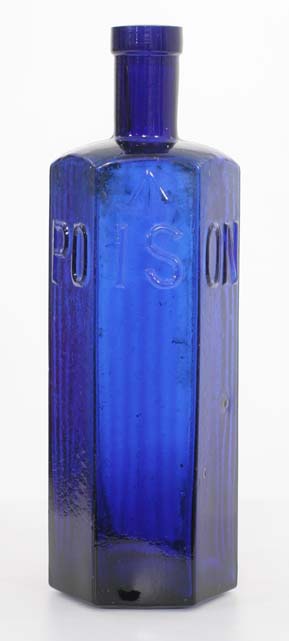
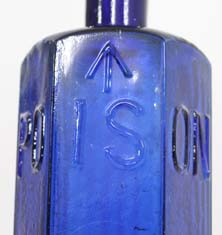
18 oz poison

18 oz Hexagonal blue poison

Very large cobalt blue hexagonal poison with arrow above the word POISON. (18 oz) 

 22.86 c. x 7.62 cm.                                                                    


Photos kindly provided by Vernon Erwin.

close-up of 18 oz poison

 ribbed back of poison

Back of hexagonal poisons showing ribbing

labelled admiralty

label National Health

National Health Insurance label:  Finds from around the world suggest these bottles were associated with the Royal Navy but were they also used for a government run National Health Insurance? This very rare labeled bottle was found in England.

Height 14 cm.

A photo of this bottle appeared in the ABC Magazine and this is the reply from the editor ABC Magazine published in 2005 in Issue 23 page 23:

“An intriguing find; the broad arrow certainly indicates a UK military issue and it therefore seems reasonable to assume the N stands for navy. National Insurance on the label refers to the National Insurance Act of 1911 which was one of the earliest steps towards the creation of the current welfare state.  It was first proposed in the 1908 “Peoples Budget” of David Lloyd George and the scheme came into effect in July 1912, with the aim of creating a national system of insurance for working people against illness and unemployment. All wage-earners aged 16 and 70 were obliged to contribute 4 pence per week, while employers paid 3 pence and the state 2 pence, In return workers were entitled to a level of free medical care and advice and a dole of 7 shillings per week for up to 15 weeks per year in the event of unemployment. My guess is that Timothy Whites bought up (or were supplied with) a job lot of navy-issue poisons during a period of national shortage ( perhaps WW1) for use in the UK’s first free medical care system. "

green poison

At least one size in this series was produced in the typical emerald
green used for Victorian poisons.  

Photo kindly provided by Alan Blakeman BBR Auctions England in October
2007 No dimensions or provenience were provided.
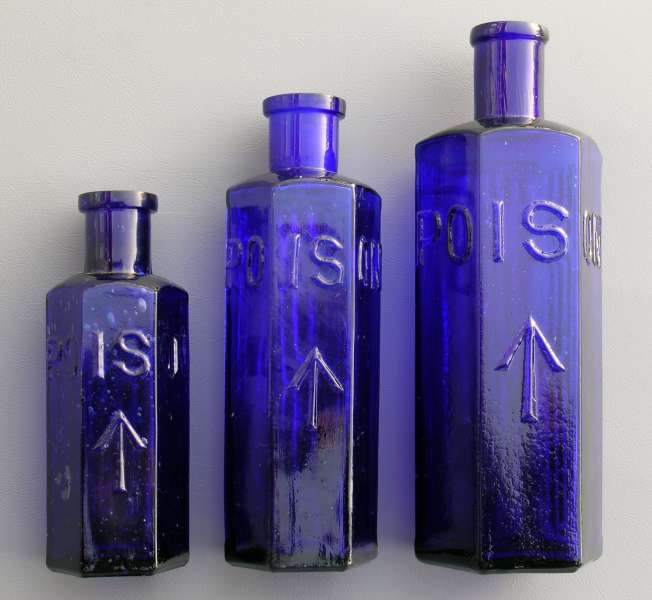
Hexagonal poisons: Large Arrow

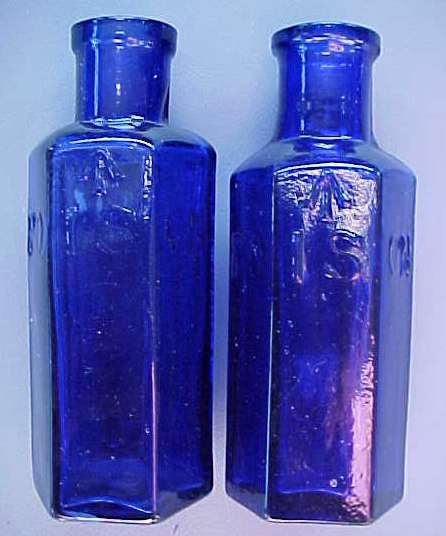
hexagonal group of admiralty poisons

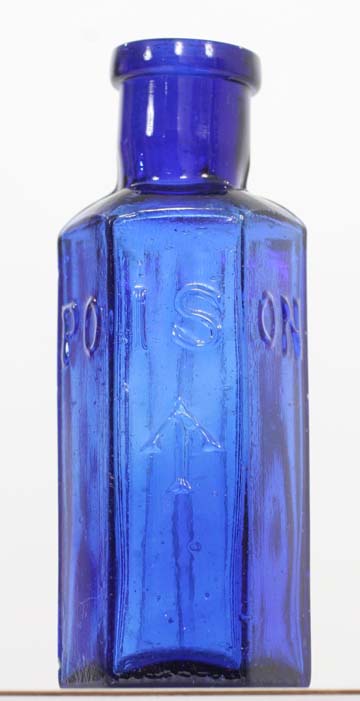
hexagonal blue poison with footed arrow

Hexagonal blue poison


Very small cobalt blue hexagonal poison with a "Footed" arrow below the word POISON. 

Base 3.175 cm. 

Height: 8.25 cm  

Photos kindly provided by Vernon Erwin.

 hexagonal poison

#302010:

Hexagonal blue poison

Base 3.5 cm. 

Height: 11.0 cm.


Hexagonal blue poison height 13.5 cm

#3002011:

Hexagonal blue poison

Base 3.8 cm. 

Height: 13.5 cm.


Hexagonal blue poison height 16 cm

#3002012:

Hexagonal blue poison

Base 5.7 cm. 

Height: 16.0 cm.


hexagonal "WD" poison

#3002013:  Hexagonal blue poison with "WD" and 
"Not to Be Taken"

Base 5.7 cm.      Height: 16.0 cm.

Marked WD with an arrow, opposite side has three ribbed panels and NOT TO BE TAKEN.  This bottle was found in County Meath, Ireland. As far as I know this particular variation has only been found in Ireland.

close-up of admiralty arrow

Etched Admiralty Arrow Bottles:

green bottle with acid etched arrow

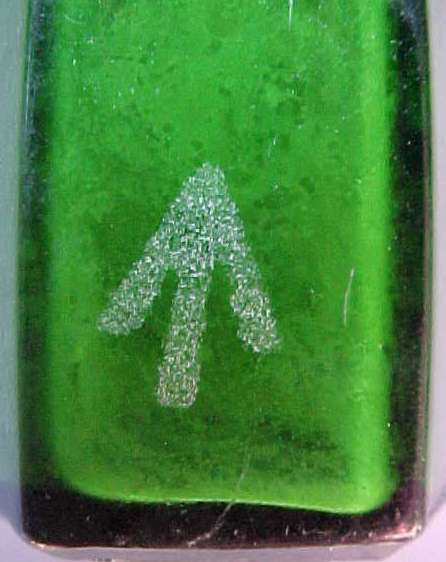
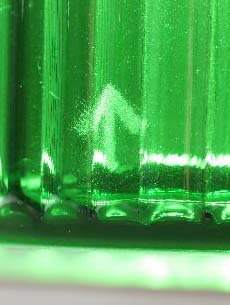
Machine made acid etched green hexagonal poison with 3 ribbed panels.  This bottle was originally found in Cyprus.  These bottles have also been found in blue and probably date sometime between the first and second war.

Base 2.8 cm. (widest point)     Height: 8.0 cm.

close-up of green bottle with acid etched arrowblue etched arrow

hexagonal green poison

Machine made acid etched green hexagonal poison with 3 ribbed panels. Blurred manufacturer's mark on base.  Probably dates from around the time of the second world war.

Base 5.5 cm. (widest point)     Height: 18.0 cm.

close-up of etched arrow

machine made etched arrow poison

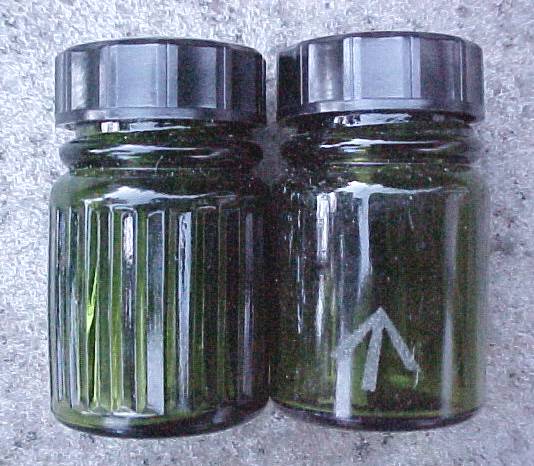
Machine made acid etched green round poison with one half ribbed and a black screw cap. On base a 1 above a 2 and a maker's mark.

These bottles were part of a military surplus sale in London just after the second war.  I have a few extra examples of these bottles.

Base diameter 3.1 cm. 

Height: 5.0 cm.


green ribbed poison with etched arrow


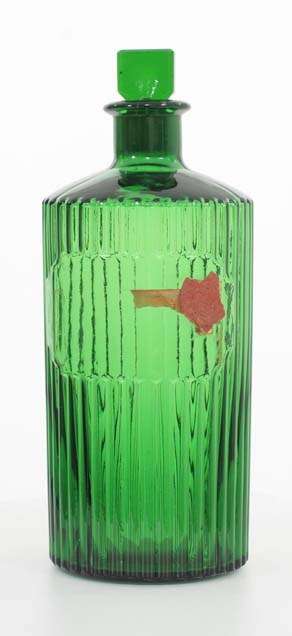
Large round green ribbed poison bottle with stopper and a "Medical Depot-Deptford" wax seal, plus a small acid etched  arrow on the lower back. Height: 22.86 cm.      Base  10.16 cm.

Photos kindly provided by Vernon Erwin. close-up of arrowclose-up of seal

OTHER Admiralty Arrow Poisons

emerald green with arrow on base

Emerald green applied lip poison bottle with one half of the bottle ribbed (the other half smooth) and a colourless stopper that appears to be original. This bottle likely dates to around the WW1 era and is marked with a broad arrow and the number 40 on the base. The volume is in fact 40 ounces and the height is 25.5 cm. (29. 0 with the stopper) and 9.5 cm. in diameter.  It would be interesting to see if similar marked bottles turn up in an archaeological context.   

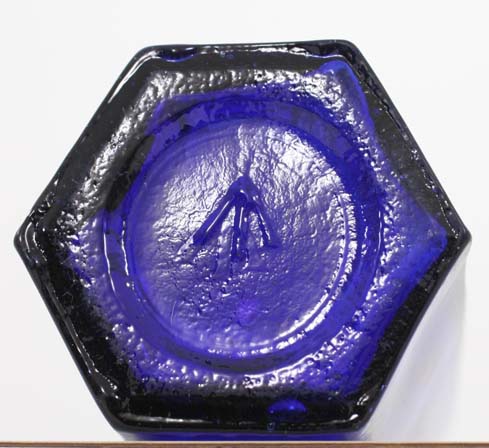
arrow on base

Blue Not to Be Taken poison with arrow on base

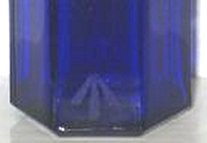
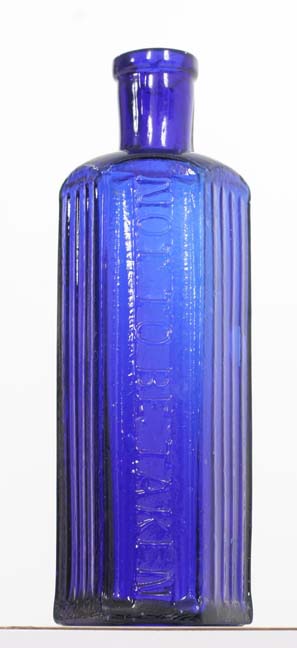
An unusual cobalt blue hexagonal 'Not To Be Taken' poison with the arrow embossed on the base.

Height: 15.24 cm  Base: 5.08 cm 

Photos kindly provided by Vernon Erwin.

base of blue "Not to be Taken"

Click on each picture to see larger images.
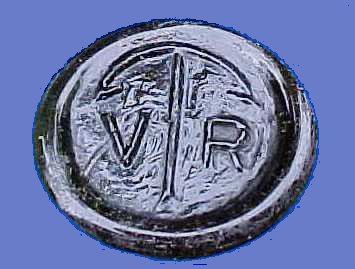
VR and anchor seal

This site created by Tom Bown and maintained by Linda Bown. Email us with comments.

 

IMPORTANT NOTICE: The images presented at this online gallery are copyright-protected © worldwide by Tom Bown. Any downloading, copying, distributing or other unauthorized use without prior written consent of the copyright holder is strictly forbidden.
Last updated Nov 2009